
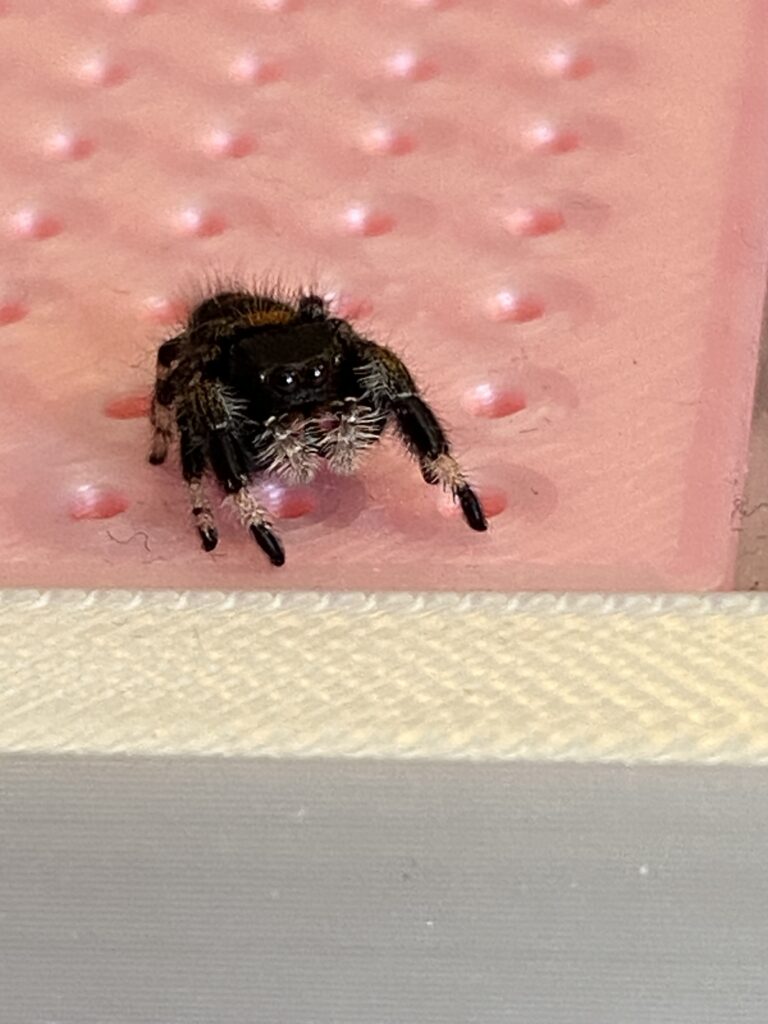
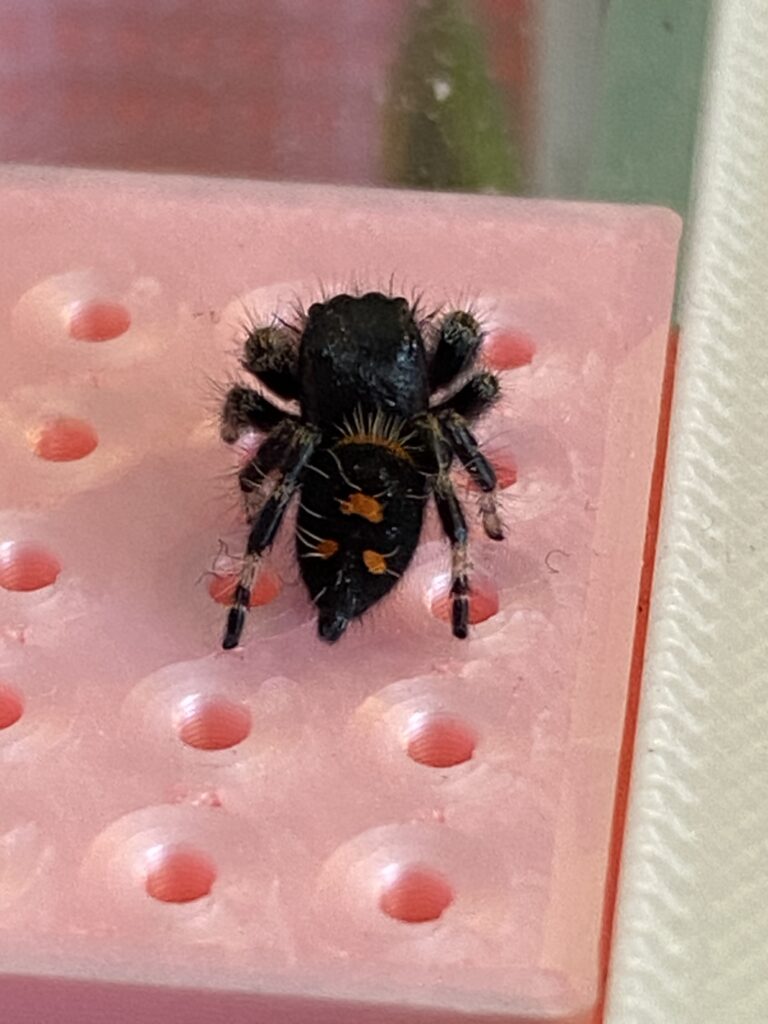
One of the tiniest and most delicate little creatures in my care right now is Pumpkin, my beautiful Florida Orange Phidippus regius.
When a jumping spider is still very small and young, everything feels more delicate. Their size makes them incredibly fascinating, but it also means their care needs a little more attention, a little more patience, and a lot of gentleness. With older or larger jumpers, things can feel a bit more forgiving. With tiny spiderlings and young juveniles, even small details matter much more.
Pumpkin is a Florida Orange Phidippus regius, which is one of the most loved jumping spider types for a reason. They are intelligent, expressive, curious, and absolutely adorable. But when they are still tiny, they are also fragile, easily stressed, and more vulnerable to dehydration, poor enclosure setup, and prey that is simply too large.
So here are some of the most important things I have learned and pay attention to when caring for a very small young jumping spider like Pumpkin.
1. A small, safe enclosure matters
When a jumping spider is still tiny, the enclosure should match that size.
A space that is too large can make it harder for the spider to find prey, harder to monitor their eating, and more stressful overall. A very young jumper does not need a huge fancy setup. What they need is a safe, manageable space where they can climb, rest, and hunt without too much difficulty.
For very young spiders, I prefer something simple and secure, with:
- proper ventilation
- enough height to climb
- soft, safe decor
- no gaps they can escape through
- easy visibility so I can monitor behavior and feeding
Tiny jumpers can get through spaces you would never expect, so enclosure security is especially important at this stage.
2. Hydration is extremely important
A very small jumping spider can dehydrate more easily than an older one, so moisture needs to be handled carefully.
That does not mean making the enclosure wet or damp all the time. It means offering hydration in a safe and controlled way. I like to provide light misting where appropriate, while making sure the enclosure still has good airflow and does not become stuffy.
Young jumpers are tiny, and water droplets must be safe for their size. The goal is to provide access to moisture without creating unnecessary risk.
This stage is all about balance:
- not too dry
- not too wet (their lungs are on their bottom part. Too wet equals to a risk of drowning!!!)
- never stuffy
- always well ventilated to avoid mold
3. Prey size is one of the biggest issues
This is probably one of the most important parts of caring for a tiny jumper.
When a spider is very young, prey must be appropriately small. If prey is too large, too active, or too intimidating, it can stress the spider or simply be ignored. Tiny jumpers need tiny meals.
At this stage, feeding is not just about offering food. It is about offering food that the spider can realistically and safely handle.
A young Phidippus regius may need:
- very small feeder insects
- prey that is easy to track
- prey that does not overwhelm them
- close monitoring to make sure the food has actually been noticed
Sometimes people assume that if food is in the enclosure, the spider will eat when hungry. But with very small spiders, it is not always that simple. They can miss the prey, ignore it, or feel too insecure to hunt if conditions are not quite right.
At the moment she just switched from Drosophilas, so fruit flies, to small sized flies.
4. Less handling is usually better
As cute as they are, very young jumping spiders do not need frequent handling.
With tiny juveniles or spiderlings, I think observation is often better than interaction. A small spider is still learning, growing, hunting, and molting. At this stage, it is usually best to keep disturbance low and let them feel secure in their own space.
That does not mean never interacting. It just means respecting how small and vulnerable they are.
With babies and very young jumpers, the focus should be on:
- safety
- routine
- gentle observation
- minimizing stress
5. Molting needs extra patience
Young jumping spiders molt regularly as they grow, and this is one of the most sensitive times in their life cycle.
If a tiny jumper starts spending more time resting, hiding, or staying in their hammock, that can simply mean they are preparing to molt. During this time, they may eat less or stop eating for a bit. They may seem less interested in interaction. They may just want quiet.
That is completely normal.
When a young spider is nearing a molt, the most helpful thing is usually to leave them alone as much as possible, keep conditions stable, and avoid unnecessary stress.
Molting is hard work, especially for such a tiny body.
6. Cleanliness and simplicity help a lot
With very small spiders, I personally think simple setups are often better than overly decorative ones.
A cluttered enclosure may look pretty, but it can make it harder to:
- monitor the spider
- track prey
- spot leftover food
- notice changes in behavior
- keep things clean
For a young jumper like Pumpkin, I would always choose a setup that is safe and practical over one that is complicated.
At this stage, the goal is not to create a miniature jungle for aesthetics. The goal is to support growth, feeding, hydration, and security.
And a soft substrate to avoid injuries in case of a miscalculated jump.
7. Tiny spiders need calm, not constant worry
This one is more for the keeper than the spider.
When a jumping spider is very small, it is easy to become hypervigilant and worry about every little thing. I understand that feeling very well, especially when the spider is as tiny and precious as Pumpkin.
But one thing I keep reminding myself is that young jumpers do best when their environment is stable and calm. They do not need constant interference. They need good basic care, appropriate food, hydration, safety, and time.
Sometimes the best thing we can do is simply watch carefully, make thoughtful adjustments, and let them grow at their own pace.
Why tiny Florida Orange Phidippus regius are so special
There is something especially endearing about a tiny Florida Orange Phidippus regius. Maybe it is the softness of their coloring, maybe it is the way such a tiny creature can still feel so expressive, or maybe it is just the magic of watching a very small spider slowly grow into itself.
Pumpkin may be tiny, but caring for her reminds me that small does not mean insignificant. These little lives require real attention, real respect, and real care.
And honestly, there is something deeply beautiful about supporting such a tiny creature through its earliest stages.
Final thoughts
Caring for a very small young jumping spider like Pumpkin is a lesson in gentleness.
A tiny Phidippus regius does not need excess. They need the basics done well:
- a safe enclosure
- proper ventilation
- careful hydration
- very small prey
- minimal stress
- patience during molts
- close but calm observation
When they are this young, every detail feels a bit bigger. But with thoughtful care, these tiny little jumpers can grow beautifully.
And in Pumpkin’s case, every tiny step feels worth celebrating.